Body Worn Cameras (BWC), also commonly referred to as Body Worn Video (BWV), have become an increasingly important tool for the UK security industry.
For security guards, door supervisors, event-security teams and other frontline personnel, a body-worn camera can provide valuable evidence, help deter incidents and support the safety of both security professionals and the public.
However, using a body-worn camera is not simply a matter of purchasing a device and pressing record. Security companies need to consider SIA licensing, UK GDPR, the Data Protection Act 2018, the Data (Use and Access) Act 2025, privacy requirements, recording policies, retention periods and secure handling of footage.
This guide explains the key considerations for UK security firms using body-worn cameras in 2026.
What is a Body Worn Camera?
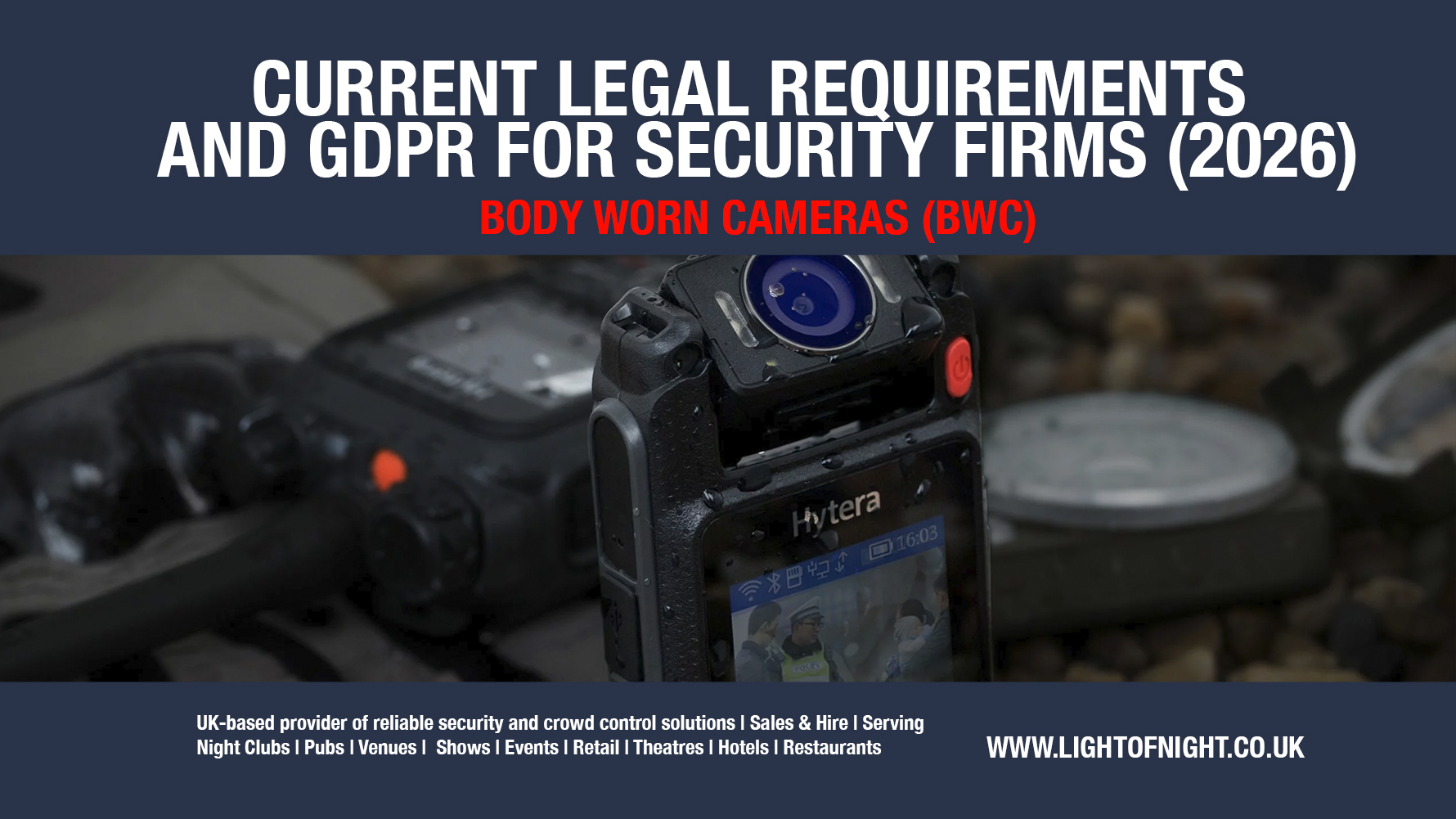
A Body Worn Camera is a small camera worn by a security operative, usually attached to a uniform, vest or harness. Depending on the model, it may capture video, photographs and audio and can sometimes transmit live footage to a control room.
Body-worn video is particularly useful in situations where traditional CCTV cannot provide a sufficiently close or mobile view.
For example, a security officer may use a BWC when:
- Dealing with aggressive or threatening behaviour
- Responding to an incident or disturbance
- Managing access to a venue or premises
- Protecting staff, customers or members of the public
- Recording evidence of an alleged offence
- Working at events, festivals or crowded locations
- Operating in areas where fixed CCTV coverage is limited
The ICO recognises Body Worn Video as a form of video surveillance and notes that it can be more intrusive than conventional CCTV, because cameras can record people at close range and may capture both video and audio.
Do Security Guards Need an SIA Licence to Use a Body Camera?
A common misconception is that wearing a body camera automatically requires a separate “bodycam licence”.
There is no standalone SIA body-camera licence. Instead, whether an operative requires an SIA licence depends on the security activity they are performing and what they do with the footage.
The Security Industry Authority (SIA) states that if a security operative uses a bodycam or headcam and watches footage captured by it as part of their job, they are likely to require an appropriate SIA licence. The licence can depend on whether their work falls within security guarding, door supervision or public space surveillance (CCTV), among other regulated activities.
Importantly, the SIA explains that CCTV licensing requirements can apply even where the footage being viewed comes from a body-worn camera rather than a conventional fixed CCTV system.
A person who simply wears a bodycam but does not watch any footage from the device may not require an SIA licence solely because of the bodycam.
Security companies should therefore assess the actual duties being performed rather than assuming that the camera itself determines the licence requirement.
Is Body-Worn Camera Footage Covered by GDPR?
Yes.
Where a body-worn camera records identifiable people, the footage will generally constitute personal data. Security companies processing that footage therefore need to comply with applicable UK data-protection law.
The ICO’s surveillance guidance specifically covers Body Worn Video and states that organisations using surveillance systems that process personal data must comply with the UK GDPR and Data Protection Act 2018.
For a security company, this means that BWC footage should be treated as personal data from the moment it is captured through to its secure deletion.
The fact that a recording may ultimately be used as evidence does not remove the company’s data-protection responsibilities.
The Importance of a Data Protection Impact Assessment (DPIA)
Before deploying body-worn cameras, a security company should consider whether a Data Protection Impact Assessment (DPIA) is required.
For BWV, the ICO specifically recommends a DPIA because the technology can be particularly intrusive. The ICO’s BWV checklist includes conducting a DPIA that addresses the impact of the system on the rights and freedoms of people whose personal data is captured.
A DPIA should consider questions such as:
- Why does the company need body-worn cameras?
- What specific security problem are they intended to solve?
- Is recording necessary and proportionate?
- When should cameras be activated?
- Will audio be recorded?
- Who can access recordings?
- Where will footage be stored?
- How long will footage be retained?
- How will footage be securely deleted?
- How will subject access requests be handled?
- How will third-party individuals be protected?
- What happens if footage is disclosed to the police, courts, insurers or solicitors?
The objective is not simply to demonstrate that the technology works. It is to demonstrate that the processing of personal data is justified, necessary and proportionate.
What is the Lawful Basis for Recording?
A security company needs to identify and document an appropriate lawful basis under the UK GDPR.
For many commercial security operations, legitimate interests may be relevant, but this should not be assumed automatically.
The organisation should consider its specific purpose, the interests it is pursuing, the necessity of the recording and the impact on the individuals being recorded.
The ICO states that organisations using surveillance systems need to identify and document a lawful basis under Article 6 of the UK GDPR. It also highlights that obtaining genuine consent in public spaces can be difficult.
This is particularly important for security firms.
A security guard should not simply record everyone continuously because the camera has that capability. The company needs a clear policy explaining when recording is justified.
When Should a Security Guard Activate a Body Camera?
One of the most important elements of a BWC policy is defining when recording should begin and end.
The ICO warns that continuous recording is likely to be excessive because it can capture people who are simply going about their daily activities and are not involved in the incident.
For example, recording may be justified when a security officer is:
- Dealing with threatening or aggressive behaviour
- Responding to a physical confrontation
- Investigating suspected criminal activity
- Protecting themselves or another person
- Dealing with a significant incident where evidence may be required
On the other hand, activating a camera simply because someone asks a security officer for directions would generally be difficult to justify.
The ICO gives a similar example: recording may be appropriate where a security guard believes someone is behaving aggressively, but may not be appropriate where an individual is merely asking for directions.
Every security company should therefore have a written BWC Activation Policy.
Audio Recording Requires Particular Care
Many modern body cameras record both video and audio.
Audio can substantially increase the privacy impact of a BWC system. Conversations can contain significantly more personal information than images alone.
The ICO specifically states that if audio and video are both recorded, the collection of both needs to be justifiable. Additional justification may be necessary when recording in sensitive environments such as private homes, schools or care homes.
Security firms should therefore ask whether audio recording is genuinely necessary for their particular use case.
Where audio is enabled, the company’s DPIA and operating procedures should specifically address it.
Transparency is a major part of GDPR compliance.
The ICO recommends that organisations using BWV provide sufficient privacy information before recording. Depending on the circumstances, this can include:
- Clear signage
- A verbal announcement
- A visible recording indicator or light
- Information provided through the organisation’s privacy notice
Staff operating the cameras should also be trained to inform individuals that recording may take place when this is not already obvious.
A practical security-company procedure might therefore require an operative to say something similar to:
“This interaction is being recorded on body-worn video for security and evidential purposes.”
The exact wording should be incorporated into the company’s approved BWC policy and adapted to the circumstances.
There is no universal UK GDPR rule stating that every security company must retain bodycam footage for a particular number of days.
Instead, the retention period should be based on the purpose for which the footage was collected.
The ICO states that UK GDPR and the Data Protection Act 2018 do not prescribe a specific minimum or maximum retention period for surveillance systems. Organisations should determine how long information is required for its stated purpose and avoid retaining personal data for longer than necessary.
A security firm should therefore establish a documented retention schedule.
For example, its policy might distinguish between:
Routine footage
Footage with no evidential or operational value should be automatically deleted after the company’s defined retention period.
Incident footage
Footage relating to an incident may need to be retained for longer where there is a legitimate and documented reason.
Evidence requested by police or another authorised organisation
The relevant footage may need to be preserved and disclosed through an appropriate process.
The key principle is that retention should be purpose-driven, documented and regularly reviewed.
Keeping Bodycam Footage Secure
Security companies should consider the entire chain of custody for BWC footage.
Appropriate safeguards can include:
- User authentication
- Role-based access controls
- Encryption
- Secure upload and storage
- Audit logs
- Restrictions on copying footage
- Secure deletion
- Controlled export of evidence
- Staff training
- Procedures for lost or stolen devices
- Regular review of access permissions
This becomes particularly important where cameras are capable of transferring footage wirelessly or integrating with wider communications systems.
For example, the Hytera VM780 available through Light of Night incorporates AES256 encryption and supports video, audio, image recording and real-time video streaming.
Technology can help support good data security, but it does not replace the need for appropriate organisational policies and access controls.
Individuals have data-protection rights concerning their personal information, and bodycam footage may form part of the information covered by those rights.
Security companies should therefore have a process for handling requests for footage.
This can become complicated where a recording contains multiple people.
For example, a recording might show:
- The person making the request
- Security officers
- Other members of the public
- Employees
- Witnesses
- Children
- Victims or alleged offenders
The company may therefore need to review and redact footage before disclosure.
The ICO specifically recommends that organisations using BWV have effective procedures for retrieving footage in response to subject access requests and onward disclosures, as well as the ability to blur or mask footage where necessary to protect third parties.
A security company may legitimately need to provide BWC footage to the police or another authority.
However, footage should not simply be copied and emailed without considering the relevant legal basis, security requirements and disclosure process.
Companies should have a documented procedure covering:
- Who can authorise a disclosure
- How requests are verified
- How relevant footage is located
- How the original evidence is preserved
- How exported footage is secured
- What records are kept of the disclosure
Maintaining an audit trail can also help demonstrate the integrity of evidence.
Bodycams and Employees
A BWC policy should not focus exclusively on members of the public.
Security companies should also explain to their employees how bodycams affect them.
Employees should understand:
- When they are expected to record
- When recording is prohibited
- How cameras should be positioned
- When audio should be activated
- What to do after an incident
- Who can access footage
- How footage may be used
- How long footage is retained
- What happens if a camera is lost or damaged
Training is particularly important because a technically compliant system can still create problems if staff use it inconsistently.
The Data (Use and Access) Act 2025 – What Has Changed?
Security firms should also be aware that UK data-protection law has been updated.
The Data (Use and Access) Act 2025 (DUAA) received Royal Assent on 19 June 2025 and introduced amendments to the UK’s data-protection framework. It does not replace the UK GDPR or Data Protection Act 2018, but modifies aspects of them.
Most of the principal data-protection changes in Part 5 came into force on 5 February 2026, with additional provisions relating to complaints by data subjects coming into force on 19 June 2026.
For security firms, this is another reason to ensure that privacy notices, internal procedures, data-protection policies and incident-management processes are reviewed regularly.
The underlying principle remains clear: organisations using surveillance technology need to understand what personal data they collect, why they collect it, how they protect it and how they respect individuals’ rights.
Choosing the Right Body-Worn Camera for Security Work
For professional security operations, the choice of camera should go beyond image quality.
Security companies should consider:
- Battery life
- Storage capacity
- Video resolution
- Low-light performance
- Audio capabilities
- Encryption
- Device durability
- Water and dust resistance
- Evidence-management software
- User access controls
- Charging and docking systems
- GPS capabilities
- Connectivity
- Live video streaming
- Integration with existing radio systems
Light of Night supplies and hires professional security communications and surveillance equipment, including Hytera body-worn cameras and two-way radios. The company describes itself as an authorised dealer of Hytera body-worn cameras and offers security equipment hire and sales.
Hytera Body-Worn Cameras and Two-Way Radios
For security teams looking to combine body-worn video with professional communications, Hytera provides solutions designed to integrate communications and evidence capture.
The Hytera VM780 Body Worn Camera, for example, combines a body camera with a remote speaker microphone and supports voice communications, video and audio recording, emergency functions and real-time video streaming over 3G/4G/Wi-Fi. Light of Night lists the VM780 with features including AES256 encryption, GPS and IP68 protection.
Light of Night also offers the Hytera VM685, which can operate as a standalone body-worn camera or be paired with Hytera multi-mode radio equipment. Its system can transfer captured media to a digital evidence management platform through the multi-unit charging system.
For security companies, integrating communications and body-worn video can provide a more joined-up approach to incident response.
Hytera Equipment From Light of Night
Security firms can explore Hytera body-worn cameras and communication equipment through Light of Night.
Hytera VM780 Body Worn Camera:
View the Hytera VM780 at Light of Night
Hytera VM685 Body Worn Camera:
View the Hytera VM685 at Light of Night
Light of Night security equipment shop:
Browse Body-Worn Cameras and Two-Way Radios
A Practical BWC Compliance Checklist for Security Companies
Before deploying body-worn cameras, security firms should be able to answer “yes” to the following:
Legal and regulatory
- Have we identified whether our security operatives require the appropriate SIA licences?
- Have we documented the purpose of using BWCs?
- Have we identified an appropriate lawful basis?
- Have we considered whether a DPIA is required?
- Have we reviewed our procedures against current ICO guidance?
- Have we considered the impact of the Data (Use and Access) Act 2025?
Operational
- Do we have a written BWC policy?
- Do we clearly define when recording should start and stop?
- Do staff know when audio recording is appropriate?
- Are employees trained in using the cameras?
- Do staff understand how to notify individuals that recording is taking place?
Privacy
- Is appropriate privacy information available?
- Is signage used where appropriate?
- Is recording necessary and proportionate?
- Are sensitive locations subject to additional controls?
- Do we have procedures for handling individuals’ rights?
Data security
- Is footage encrypted or otherwise appropriately protected?
- Is access restricted to authorised personnel?
- Do we maintain an audit trail?
- Is there a documented retention schedule?
- Is footage securely deleted when it is no longer required?
- Can we redact footage where necessary?
Evidence management
- Can we identify the original recording?
- Can we preserve relevant footage following an incident?
- Do we have a controlled process for exporting footage?
- Can we document disclosures to police, courts, insurers or other authorised parties?
Final Thoughts
Body-worn cameras can be an extremely valuable tool for modern security firms. They can provide evidence, improve accountability, support security officers and potentially deter unacceptable behaviour.
But the camera is only one part of a compliant BWC system.
The most important question is not simply “Which body camera should we buy?”
It is:
“Can we demonstrate that our entire body-worn video operation is lawful, necessary, proportionate, secure and properly governed?”
For UK security companies, that means considering SIA requirements alongside UK GDPR, the Data Protection Act 2018, the Data (Use and Access) Act 2025 and current ICO guidance.
A professional BWC solution should combine suitable hardware with clear policies, properly trained staff, secure evidence management and an appropriate data-protection framework.
For security firms looking for professional body-worn cameras, Hytera equipment and two-way radio solutions, Light of Night provides equipment for sale and hire, together with delivery, repair and customer support services.
Important: This article is intended as general information for UK security businesses and is not legal advice. Organisations should obtain professional legal or data-protection advice for their specific surveillance arrangements.