
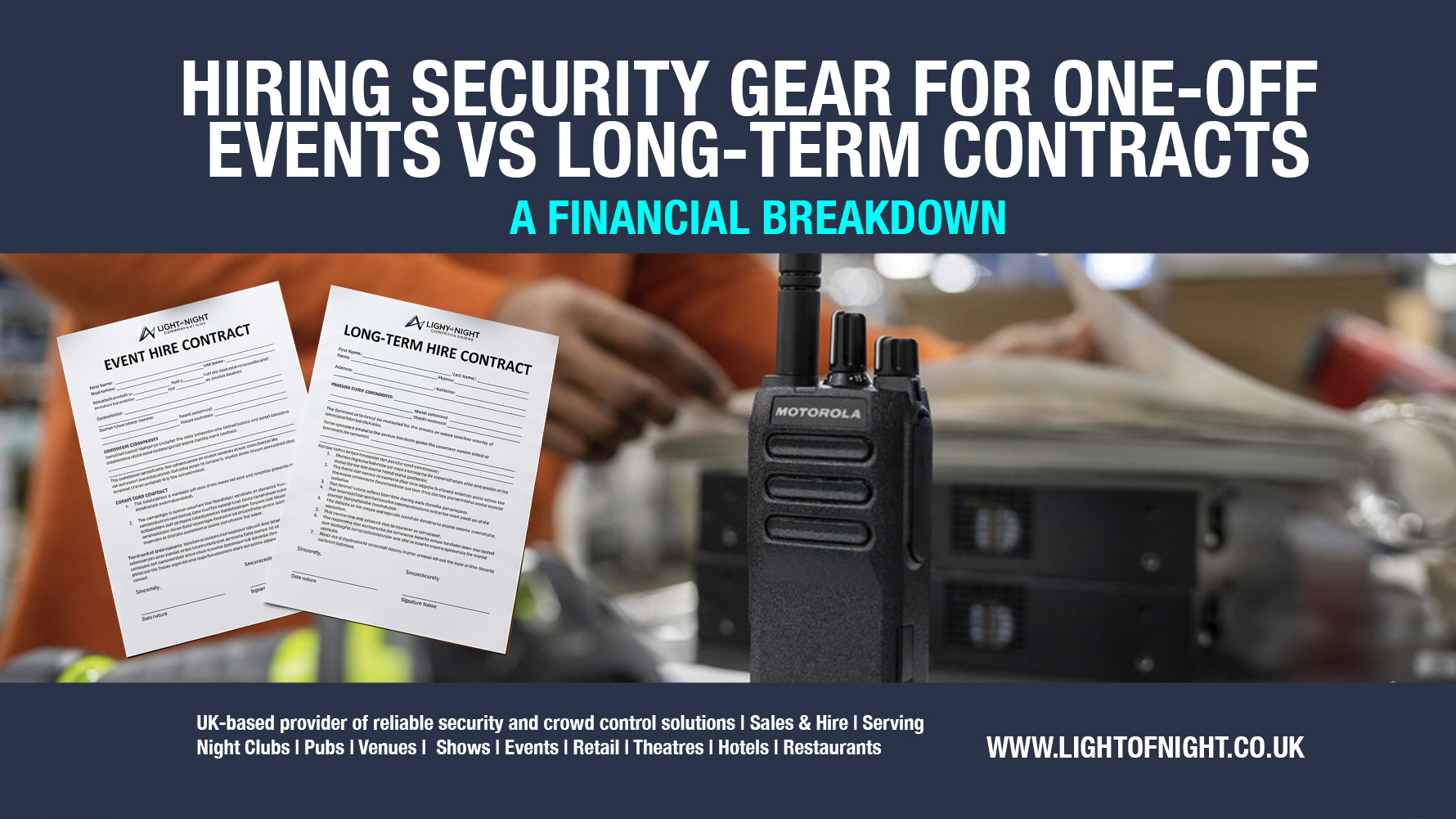
Managing security for any venue or gathering requires a balancing act between strict risk management and operational cash flow. Security and crowd management hardware—ranging from licensable Motorola two-way radios and Hytera body-worn cameras to metal detectors, hand tally counters, and stanchions—is essential for public safety and regulatory compliance. However, outright purchasing capital-intensive kit is rarely the most cost-effective path for event organisers and operations teams.
For pop-up venues, corporate event planners, and seasonal operators, the decision usually comes down to choosing between one-off short-term rentals and long-term hire agreements.
Based on services offered by UK security equipment specialists like Light of Night, this financial breakdown evaluates the direct costs, hidden operational expenses, and flexibility factors to help you determine the correct hire model for your venue.
1. One-Off Event Hire (Short-Term Rentals)
Short-term hiring caters to events running anywhere from a single night to a couple of weeks. This model is ideal for single corporate galas, pop-up experiential spaces, single weekend festivals, and short-run theatrical performances.
Financial Structure
- Cost Model: Pay-per-week or pay-per-event rates.
- Capital Outlay: Zero capital expenditure (CapEx); 100% operational expense (OpEx).
- Maintenance & Licensing Costs: Fully covered by the supplier.
Primary Advantages
- Optimised Cash Flow: You only pay for hardware during the exact weeks your venue is generating revenue. Assets do not sit on a shelf losing value during off-peak periods.
- Fully Programmed & Compliant Kit: Short-term hires from professional suppliers come fully charged, pre-configured, and compliant with relevant Ofcom radio frequencies. For example, licensable Motorola two-way radios are supplied ready to operate without requiring your business to manage independent frequency licensing.
- Tailored Scalability: A corporate brand launching a weekend pop-up can order 10 body-worn cameras, 20 radios, and 50 barrier stanchions for three days, returning the entire inventory immediately afterwards.
Potential Financial Pitfalls
- Higher Weekly Equivalent Unit Rates: On a purely per-week metric, short-term rentals carry a higher rate than extended hire contracts.
- Repeated Logistics Expenses: Frequent delivery and pick-up fees can add up if short-term hires are placed back-to-back without long-term planning.
2. Long-Term Equipment Hire
Long-term rental contracts typically span several months to a year or more. This structure suits seasonal operators (such as summer outdoor venues or winter markets), recurring nightclub venues, retail security teams, and long-running production runs.
Financial Structure
- Cost Model: Discounted weekly or monthly retainer billing.
- Capital Outlay: Predictable, low OpEx with fixed regular payments.
- Maintenance & Repair: Usually backed by technical support and rapid replacement guarantees.
Primary Advantages
- Significant Unit Discounts: Long-term hire agreements dramatically reduce the effective weekly cost per unit. For multi-month activations, the cost savings compared to aggregated weekly rates can reach 40% to 60%.
- Predictable Budgeting: Fixed monthly invoices make cash flow forecasting straightforward, eliminating unexpected security compliance expenses midway through a season.
- Ongoing Service & Support: Leading security communications suppliers offer continuous support, technical assistance, and swap-out options for faulty equipment or worn batteries. This eliminates maintenance, recalibration, and battery degradation costs that plague owned equipment over time.
Potential Financial Pitfalls
- Idle Asset Costs: If event schedules change or attendance dips during off-peak weeks, you remain contractually obligated to pay for the equipment.
- Storage and On-Site Handling: Long-term hires require secure on-site storage, charging stations, and inventory management over the duration of the contract.
Direct Financial Comparison Matrix
| Expense Category | One-Off / Short-Term Hire | Long-Term Hire | Outright Purchase (Reference) |
|---|---|---|---|
| Initial Upfront Cost | Minimal (Deposit + Rental Fee) | Low (First Period Retainer) | High (Full CapEx Purchase) |
| Weekly Rate Efficiency | Standard Rate | Highly Discounted | N/A |
| Ofcom Licensing & Setup | Included by Supplier | Included / Managed | User Responsibility & Cost |
| Maintenance & Repairs | Supplier Responsible | Supplier Responsible | Owner Responsible |
| Depreciation Risk | Zero | Zero | High (Batteries & Tech Degrade) |
| Flexibility | Maximum (Scale up/down per event) | Medium (Fixed contract duration) | None (Assets Locked) |
Decision Framework: Which Model Fits Your Profile?
Scenario A: Pop-Up Venues & Experiential Events
Recommended Model: One-Off Event Hire
Why: Pop-up ventures operate with limited lead times and tight operational windows. Renting two-way radios, hand tally counters, and crowd-control rope stanchions on a short-term basis ensures you avoid sitting on idle hardware once the activation ends.
Scenario B: Corporate Event Planners & Agency Organisers
Recommended Model: Hybrid Approach (Short-Term Hire per Project)
Why: Corporate event calendars fluctuate throughout the year. Renting specific security packages—such as metal detector wands, earpieces, and body-worn cameras tailored to each event’s delegate count—keeps costs strictly tied to client budgets.
Scenario C: Seasonal Operators & Multi-Month Venues
Recommended Model: Long-Term Hire
Why: Summer rooftop venues, winter ice rinks, and multi-week festival grounds require equipment on-site continuously for 3 to 6 months. A long-term hire structure provides the lowest unit rate while avoiding the long-term maintenance, licensing, and battery replacement headaches of direct ownership.
Conclusion
Choosing between one-off security hire and a long-term contract comes down to matching your operational timelines with the right financial model. Short-term rentals protect cash flow and eliminate waste for short activations, while long-term contracts provide maximum unit-cost efficiency for sustained venue operations.
By sourcing from an experienced security equipment provider like Light of Night—which supplies fully serviced two-way radios, crowd control barriers, metal detectors, and body-worn cameras across the UK—venue operators can ensure full safety compliance without overextending their operational budgets.